Contemporary Collage
Suprematismus im XXI. Jahrhundert
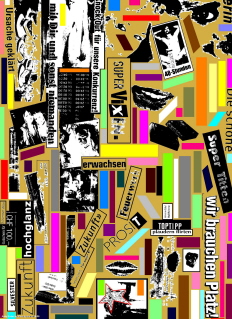
Bei diesen Kompositionen kann man zeitgleich feststellen, wie die schwarzen und die farbigen Formen dem Suprematismus nahekommen. Wobei die farbige suprematistischen Elemente sich in den Vordergrund drücken. Der Betrachter sieht in aller erster Linie zwei unterschiedliche Details. Jedoch erst wenn man genauer betrachtet, erkennt man die Zusammenhänge und die Zugehörigkeit der Formen, Bilder und der Textzeilen. Heute überwiegt in dem Wort die Qualität, wenn in die Taschen der Manager Unsummen von Boni einfliessen oder wenn möglichst viele Menschen günstig hergestellte Massenprodukte kaufen oder wenn die Berühmtheiten von den Medien Zigmillionen erhalten. Man behauptete damals vom Suprematismus, dass man diese Kunstrichtung links liegen lassen werde auf dem direkten und einzigen Wege über das Material zur Qualität und es war der Gegenseite nicht mangelfrei klar, welchen Platz der Suprematismus in der neuen Kunst und der Welt einnehmen werden sollte. Die Bevölkerung wird irregeführt, in dem man mit den Medien unwichtig sowie desorientierend Bericht erstattet. Als gutes Beispiel kann man die Gratiszeitungen erwähnen. Mit Werbung erschafft man Massengeschmack und die Berichterstattung wird auch nebenbei geklittert. Der Suprematismus Malewitschs basierte auf der Idee, dass die Malerei mit ihrer äusseren Vision in erster Linie seelische Zustände formuliert und damit seelische Reifungsprozesse zu berichten hat. Diese Erscheinungen in der Gesellschaft führen letztendlich zur Ansichten des Suprematismus. Man redet von der Freiheit, Menschenrechte sogar von der Demokratie. Alles ausgeschmückt mit schmeichelnden Wörtern. Einzig der Suprematismus kritisierte die Gesellschaft und kündigte an, die Unabhängigkeit der neuen Gesellschaft. Hier ist zu beachten, dass Malewitsch die Kunst auf das Null reduzierte. Der Suprematismus Malewitschs kann mit dem Bild "Badende Männer (1928-32)" oder mit der zweiten Bauernzyklus (1928-32) diese These vertiefen. Das Bild "Badende Männer" zeigt drei Männer stehend und die ungewöhnlich konkreten Gesichter der beiden äusseren Individuen stehen neben dem leeren Haupt der Hauptfigur. Möglicherweise möchte Malewitsch ausdrücken, dass diese Menschen trotz aller ihrer ausdrucksvollen individuellen Züge angesichts ihres Schicksalsfügung einander ähnlich sind. Mag ihre Auflehnung ausreichend kräftig sein, sie sind einflusslos in ihrer Nacktheit vor dem Bösen in seiner komischen Errungenschaft. Es war der vom Künstler entdeckter Suprematismus, der ihm auch beim zweiten Bauernzyklus, die künstlerischen Mittel ermöglichte, mit Emphase das Leitmotiv des im Leben jauchzenden Bösen zu objektivieren. Punin bezeichnete den Suprematismus als eine Sekte. Jedoch verstand er es nicht, dass der Künstler Kasimir Malewitsch eine neue Epoche angekündigt hatte, um die Gesellschaft aufmerksamer zu machen. Trotzdem bezeichnete Punin in seinem Artikel "Ein Ueberblick über neue Strömungen in der Kunst Petersburgs" im Jahre 1923, den Suprematismus als Weltanschauung. Malewitsch selber erklärte in seinem Manuskript datiert mit März 1924, welches möglicherweise auch zum Kreis "Ideologie der Kunst" gehört, den Suprematismus als das Verhältnis zwischen der Kunst und der Gesellschaft. Daher sind diese "Contemporary Collage" Arbeiten die Analysierung der Gesellschaft. Es sind Texte, Bilder sowie Artikel, welche in den Köpfen der Mitmenschen tagaus Harmonie, Illusion, Bedenken, Verbundenheit, Schock etc. auslösen und angesichts ihres Schicksalsfügung einander ähnlich sind. Trotz der Auflehnung sind sie einflusslos in ihrer Blösse vor dem Bösen in seinem komischen Erfolg. Viele befürchten, dass die Wahrheit der Untergang sein kann oder ist. Auch der Leopold II. kämpfte gegen die Wahrheit, in dem er ein Medienimperium errichtete und falsche Meldungen verbreiten liess. Noch heute schmückt Bronzestatuen von Leopold II. die Anlagen und Plätze rundum in Belgien. Hans A. Pestalozzi erzählt in seinem Werk "Auf die Bäume ihr Affen" ausführlich über die Ereignisse der Neuzeit. Zum Beispiel erwähnt er, dass die Information gefährlich ist, weil sie dich zum Denken bringen könnte. Er sagt folgendes über den Westen. Der Westen vertritt das Argument "Für unsere Exportindustrie liegt in der Dritten Welt (Entwicklungsländer) ein riesiges Wachstumpotenzial." und er argumentiert, dass mit diesem Konzept der kapitalistische Sachverständigenrat genau die marxistische These vertretet, dass der Kapitalismus nur solange zu überleben vermag, in dem er irgendwo auf der Welt noch irgendwelche unmodernen Gebiete ausbeuten kann. Heute sind diese unmodernen (rückständigen) Gebiete klar definiert. Siehe Irak, Syrien, Libyen, Algerien, Aegypten, Kongo, Nigeria, Somalia, Kuba et cetera. Explizit fragt er, ob man noch nie etwas von Schuldenkrise, Nord/Süd Konflikt, wirtschaftlichem Kolonialismus gehört hat, oder ob man sich nie überlegt hat, wie die Dritte Welt unsere überflüssigen Exportgüter finanzieren soll. Ausführlich fragt er, ob diese Menschen noch mehr Tropenwälder abholzen, noch mehr Gemüse in der Sahelzone für unseren Luxus anbauen oder noch mehr Viehfutter für unsere Rinder statt Nahrung für die eigene Bevölkerung versorgen müssen. Pestalozzi erwähnt auch in seinem Werk, dass der Kolumnist der Zeitung "Die Welt" offen zum Krieg aufrief, als 1979 eine neue Oelkrise drohte. Der Kolumnist schrieb damals: "Noch ist die Fahrt in eine neue Wirtschaftskrise zu stoppen; mit militärischen Mitteln." Falls Gaddhafi dem Westen kein Oel mehr liefern sollte: "Die Antwort kann nur lauten; Einmarsch.". Pestalozzi fügt später mit den Sätzen an, dass ein Manager ist ein Manager ist ein Manager, ist, und sie alle gleich sind, und, er fragt ob man je gehört hat, dass sich ein Topmanager gegen die Atomkraft geäussert hat, sich für sanfte Technologie eingesetzt hat, den biologischen Landbau befürwortet hat, sich in der Friedensbewegung exponiert hat, gegen Waffenexporte und "Nachrüstung" protestiert hat, sich gegen eine Autobahn und die weitere Förderung des Autowahnsinns zur Wehr gesetzt hat, in den dreissiger Jahren die Machtübernahme durch Hitler und die Nazis nicht begrüsst hat. Zu den Managern meint er, dass sie gross, gigantisch, brutal, überwiegend, rücksichtslos, hart und alle gleich sind. Er schreibt dazu: "Sie können nicht anders!". Er beschreibt die Situation der Kultur und formuliert, die Kultur sei die Gesamtheit dessen, was für eine menschliche Gemeinschaft in einer bestimmten Region typisch ist. Das Denken der Europäer habe schon immer erlaubt in ungeheuren Arroganz unzählige andere Kulturen zu zerstören und formuliert dieses als Kolonialismus. Er meint heute sind es die drei Faktoren, nämlich, westliche, nicht angepasste Technik; westliche, ausbeuterische Wirtschaftsprinzipien; westlicher Lebensstil und als Beispiel nennt er den Tourismus. Er fügt an, dass heute noch zuviele Menschen die Kolonisatoren in Afrika, Amerika, Australien et cetera loben würden und diesen häufigen Satz dafür verwenden "Sie haben die Zivilisation nach Afrika und in den unzivilisierten Erdteil gebracht.". Er schreibt auch über die politische Kultur, und, dass man früher von Bananenrepubliken gesprochen hat, wenn man eine kulturlose Nation gemeint hat; er analysiert in seiner Schrift diese so; dass es heute überall Lüge, Bestechung, Korruption an der Tagesordnung ist und somit die Welt eben auch der Westen eine Union aus Bananenrepubliken ist. Er bringt auf den gewissen Punkt in dem er über die Kulturlosigkeit weiter formuliert und erläutert, dass das zweite untrügliches Zeichen für die eigene Kulturlosigkeit der krampfhafte Versuch ist, irgendwo auf der Welt einen neuen kulturellen Rahmen zu finden. Er benennt diese Kulturlosigkeit New Age-Theater. Ueber die Kultur schreibt er auch diesen Satz: "Wer zahlt, befiehlt." und erwähnt das legendäre Zitat von Nägeli (Der Sprayer von Zürich): "Der Staat - der korrupte Alte - gibt selbstverständlich nie umsonst, ohne Gegenleistung geht es nie!". Aus dieser Voraussetzung entstand "Contemporary Collage" und ist eine Analyse in soziologischer Philosophie. Die Farben, Texte, Bilder sind die monochrome Landschaft der Gesellschaft und die suprematistische Formen ist der Nullpunkt der Kulturlosigkeit des XXI. Jahrhunderts.
"Radikale Theorien sind aussichtslos gegen das Böse." Andy Ender
Contemporary Collage
Suprematism in the 21st century
In these compositions, one can to assess at the same time how the black and the colored forms approach the suprematism. Whereby the colored suprematistic elements press themselves into the foreground. The contemplator sees two different details primarily. However first if one more exactly contemplate, one recognizes the contexts and the belonging of the forms, pictures and the text lines. Today the quality predominates in the word if into the pockets of the managers enormous sums of bonuses flow in, or if preferably many people buy cheap mass-produced products, or if the famous people receive from the media gazillion. One predicated at the time of suprematism, that one this art movement to ignore on the direct and only way over the material to the quality and it was the opposition not flawless clear, which place the suprematism in the new art and the world should take up. The population becomes misled, in that one with the media unimportantly as well as disorientating report. As a good example, one can mention the free newspapers. With advertising, one creates mainstream and the reporting becomes also incidentally misrepresentation. Malevichs suprematism was based on the idea that the painting with its external vision formulated primarily mental conditions and has to report therewith mental gestation process. These aspects in the society lead finally to the views of the suprematism. One speaks of the freedom, human rights even of the democracy. Everything embellished with flattering words. Only the Suprematismus criticized the society and announced, the independence of the new society. Here is to be noted that Malevich reduced the art on the zero. Malevichs suprematism can with the picture "Bathing of men (1928-32 )" or with the second farmer cycle (1928-32) this thesis to intensify. The picture "Bathing of men" shows three men standing and the unusually concrete faces of both external individuals stand next to the empty head of the principle figure. Possibly Malevich would like to express that these people are similar in spite of all of theirs expressive individual traits in view of theirs fate one another are related. If theirs insurrection sufficiently strongly likes to be, they are uninfluential in theirs nakedness against the evil in his strange accomplishment. It was that by the artist discovered suprematism, that him also in the second farmer cycle enabled the artistic way to objectify with emphasis the keynote of the in life exulting evil. Punin designated the suprematism as a sect. However he did not understand it, that the artist Kazimir Malevich had announced a new epoch in order to make the society more attentively. Nevertheless designated Punin in his article "An overview over new currents in the art of Petersburg" in 1923, the suprematism as a world view. Malevich itself explained in his manuscript dates with March 1924, which belongs possibly also to the circle to "Ideology of the art", the suprematism as the ratio between the art and the society. Therefore are this "Contemporary Collage" works the study of the society. There is texts, pictures as well as article, which release in the people's minds of the society day after day harmony, illusion, objection, solidarity, shock etc. and are similar in view of theirs fate one another are related. In spite of the insurrection, they are uninfluential in theirs bareness against the evil in his strange accomplishment. Many to fear that the truth can be the downfall or is. Also the Leopold II fought against the truth, in which he founded a media and let propagate incorrect news. Yet today bronze statuary of Leopold II decorates the plants and places all around in Belgium. Hans A. Pestalozzi tells in his work "Auf die Bäume ihr Affen" in detail over the events of the modern age. For example he mentions that the information is dangerous, because it could bring you for thinking. He says following over the west. The west represents the argument "For our export industry is in the Third World (developing countries) a gigantic growth potential." and he argues that with this concept the capitalistic counsil of experts represents exactly the Marxist thesis, that the capitalism is able to be still extant only as long as, in that it somewhere in the world any emerging countries to exploit may. Today these developing countries clearly are defined. Look at Iraq, Syria, Libya, Algeria, Egypt, Congo, Nigeria, Somalia, Cuba et cetera. Explicitly he asks whether one heard never something of dept crisis, north/south conflict, economic colonialism or whether one never considered, how the Third World should to finance our not needed export goods. In detail he asks whether these people still more tropical forest to deforest, still more vegetable to cultivate in the Sahelian zone for our luxury or still more fodder for our cows instead of nourishment for the own population to provide to need to. Pestalozzi mentions also in his work that the columnist of the newspaper "Welt" called openly to the war, when 1979 threatened a new oil crisis. The columnist wrote at that time: "Yet the trip is to be stopped into a new economic crisis; with military means". If Gaddafi should deliver no more oil to the west: "The answer only can to be; invasion". Pestalozzi to annex later with the sentences, that a manager is a manager is a manager, is, and they all are same, and, he asks whether one ever heard, that a Topmanager against the nuclear energy to be expressed, soft technology has supported, the biological agriculture has endorsed, itself in the peace movement has exposed, protests has against weapon exports and retrofitting, to take a stand against a freeway and the further support of the car insanity, in which thirties the takeover did not welcome by Hitler and the Nazis. To the managers, he means that they are big, gigantic, savage, predominant, ruthless, hard and they all are same. He writes in addition: "They cannot differently!". He describes the situation of the culture and formulates, the culture is the entirety of this, what for a human society would be typical in a specific region. The thinking of the Europeans have already permitted with enormous arrogance other cultures to destroy and formulates this as a colonialism. He means today are the three factors, that it to say, western, not appropriate technology; western, exploitative economy principles; western lifestyle and as an example he names the tourism. He to annex that today yet too much people would praise the colonists in Africa, America, Australia et cetera and this common sentence for that use: "They have the civilization to Africa and into the uncivilized part of the world brought.". He writes also over the political culture, and that one spoke in former times about banana republics, if one meant a cultureless nation; he analyzes in his writing as; that today is everywhere at the order of the day falsehood, bribery, corruption and therefore the world also the west is just a union of banana republics. He comes straight to the point in that he formulated over the lack of culture and expounded, that the second certain sign for the own lack of culture is, the convulsive attempt to find somewhere in the world a new cultural frame. He names these lack of culture New Age theater. Over the culture, he writes also this sentence: "Who pays, commands." and mentions the legendary quotation of Nägeli (The graffiti artist of Zurich) : "The polity - the corrupt gaffer - gives of course never for nothing, without return service no chance!". From this prerequisite to originate "Contemporary Collage" and is an analysis in sociological philosophy. The colors, texts, pictures are the monochrome landscape of the society and the suprematistic forms the zero of the lack of culture of the 21st century.
"Radical theories are hopeless against the evil." Andy Ender
Links:
Kasimir Malewitsch auf dem Maskenball der Malerei
Von der Fläche zum Raum
Wege zur Abstraktion und zurück - Kasimir Malewitsch und sein Umfeld
Kasimir Malevich, Annely Juda Fine Art
Aktuelle Ausstellungen über Malewitsch / Current exhibitions about Kazimir Malevich:
Kazimir Malevich paintings at the "0.10" exhibition, 1915
Inventing Abstraction, 1910-1925
The Artist and the Poet
Works of the "Contemporary Collage"
Untitled, #A1SW,
2006,
print on glossy paper,
135 x 96 cm,
titled, dated, signed and stamped
Untitled, #A3A,
2008,
print on glossy paper,
135 x 96 cm,
titled, dated, signed and stamped
Untitled, #A3.SWM1,
2008,
print on glossy paper,
135 x 96 cm,
titled, dated, signed and stamped
Untitled, #A4.2A,
2008,
print on glossy paper,
135 x 96 cm,
titled, dated, signed and stamped
Untitled, #A4.2.SWM1,
2008,
print on glossy paper,
135 x 96 cm,
titled, dated, signed and stamped
System Error, #1SWM5,
2006,
print on glossy paper,
in series five works each 55 x 40 or 70 x 50 cm and unique 135 x 96 cm,
titled, dated, signed and stamped
Alles Andere ist Blech, #0036.1SW1,
2006,
print on glossy paper,
140 x 100 cm,
titled, dated, signed and stamped
Always A Smile, #0020.1SW1,
2006,
print on glossy paper,
140 x 100 cm,
titled, dated, signed and stamped
Always A Smile, #0021.1SW1,
2006,
print on glossy paper,
140 x 100 cm,
titled, dated, signed and stamped
Always A Smile, #0022.1SW1,
2006,
print on glossy paper,
140 x 100 cm,
titled, dated, signed and stamped
Fühlen Sie sich frei (Echt Hardcore), #0042.1SW1,
2006,
print on glossy paper,
140 x 100 cm,
titled, dated, signed and stamped
Fühlen Sie sich frei (Echt Hardcore), #0038.1A1,
2006,
print on glossy paper,
140 x 100 cm,
titled, dated, signed and stamped
Marc O Polo Woman, #0003.1SW1,
2006,
print on glossy paper,
140 x 100 cm,
titled, dated, signed and stamped
Très Chic, #0016.1SW1,
2006,
print on glossy paper,
140 x 100 cm,
titled, dated, signed and stamped
Très Chic, #0017.1SW1,
2006,
print on glossy paper,
140 x 100 cm,
titled, dated, signed and stamped
Ursache geklärt, #0011.1SW1,
2006,
print on glossy paper,
140 x 100 cm,
titled, dated, signed and stamped
Ursache geklärt, #0012.1SW1,
2006,
print on glossy paper,
140 x 100 cm,
titled, dated, signed and stamped
Vermischte Meldungen, #0009.1SWA1,
2006,
print on glossy paper,
140 x 100 cm,
titled, dated, signed and stamped